RMU Postdoc Career Weeks 2026
RMU Postdoc Career Weeks 2026
The RMU Postdoc Career Weeks offer information, orientation and networking specifically for the advanced PhD and Postdoctoral phase but are open to everyone.
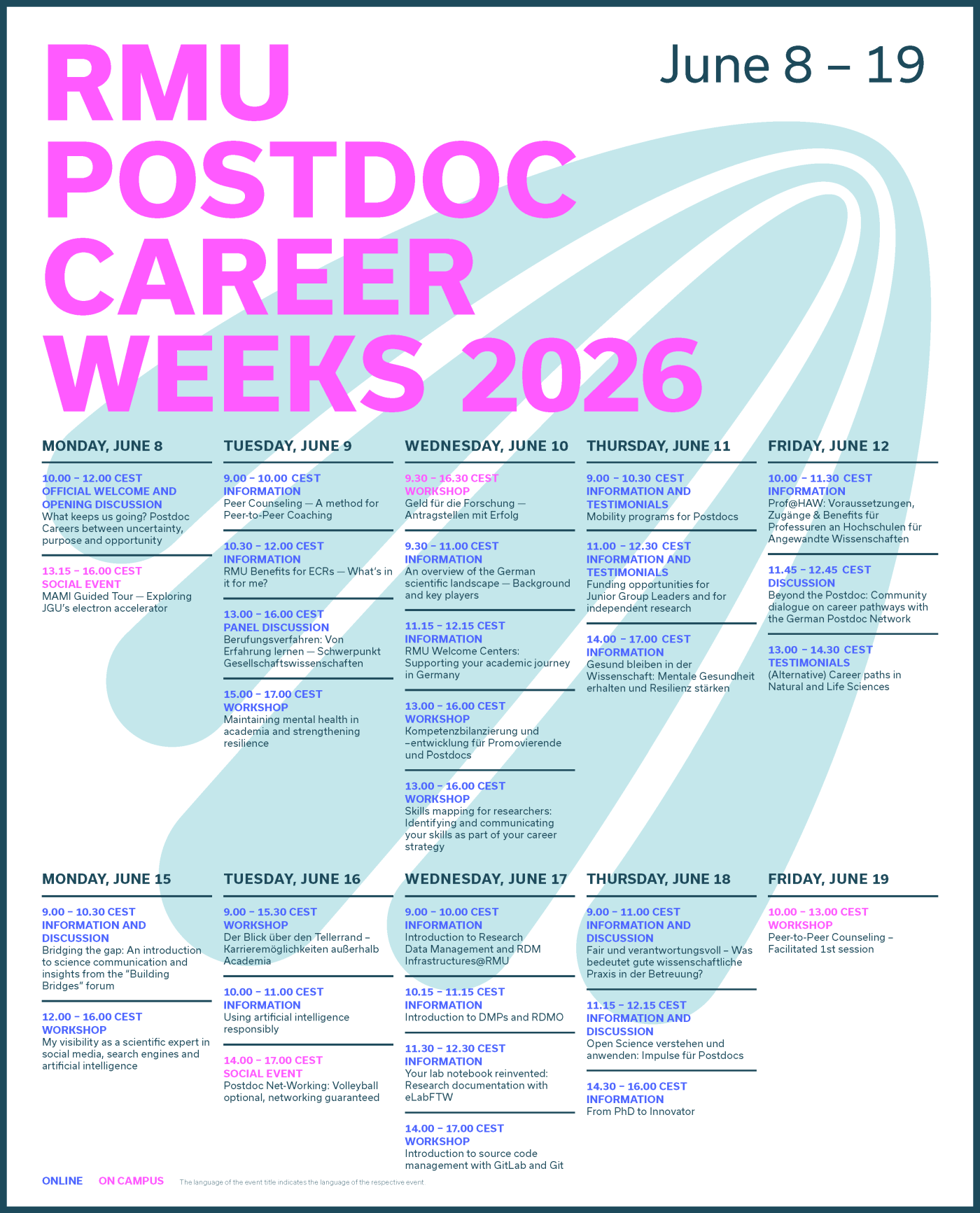
In 30 talks, discussions and workshops, as well as social and networking events you will have the opportunity to receive valuable insights on career paths in and outside academia, learn from established researchers and career experts, improve your competencies, and form new and sustainable networks.
Check out the program overview available in the download section.
For more detailed information on each event, see the full program below.
Who can participate?
The RMU Postdoc Career Weeks are designed specifically for Early Career Researchers in the doctoral phase (R1), the postdoctoral phase (R2), and the qualification phase for a professorship or equivalent (R3) from the Rhine-Main Universities (RMU): Goethe University Frankfurt, Johannes Gutenberg University Mainz and Technical University of Darmstadt.
We also invite Early Career Researchers from RMU’s European partner alliances UNITE and FORTHEM as well as from other research institutions, who are interested in research and career opportunities at the RMU, to participate.
Acceptance to events is contingent upon a limited number of available slots.
Where do the RMU Postdoc Career Weeks take place?
With a few exceptions, our events take place online and are held via Zoom.
Events on campus will take place at the Johannes Gutenberg University Campus in Mainz.
Please check the event descriptions in the program for more detailed information on the event format and location.
How can I register?
There are two types of events, for which you can register:
1. Open events
A lot of the events are open events, which means that they do not have a limited number of participants.
To participate in these open events, you need to register once by filling in this registration form.
This registration allows you to participate in all open events. There will be one link for all open events. You will receive the link with your acceptance mail.
2. Closed events (with a limited number of participants)
Some events, like our workshops or social events, have a limited number of participants and require separate and early registration.
Please check the program below early on and identify the events you are interested in. To sign up for closed events, you need to register for each event individually by filling in the registration form specifically for this event.
You may register for several events. But: Please note that your registration is binding and that you are required to cancel your registration right away if you are unable to attend. Although participation in the events is free of charge for you, the university still incurs costs. Please help us to conserve resources and be fair to other interested people.
Acceptance to events is contingent upon a limited number of available slots.
Contact
If you have any questions, please contact the organizers Jessica Werking and Dr. Laura Stein (ga@uni-mainz.de)
Registration forms
Open events: https://eveeno.com/rmu-pcw-2026
All events: https://eveeno.com/de/event-cal/46648?style=grid
Monday, June 8
Official Welcome and Opening Discussion: What keeps us going? Postdoc Careers between uncertainty, purpose and opportunity
Online
10.00 – 12.00 CEST
Between passion for research and the demands of everyday academic life, the postdoc phase can be both inspiring and challenging. High workloads, multiple responsibilities and growing complexity in academic careers – alongside broader developments such as Artificial Intelligence – raise new questions regarding motivation, resilience and career direction: Is academia structurally more stressful than other career paths? How does academic work affect the mental health and wellbeing of postdocs? How should postdocs deal with increasing uncertainty?
Following the Official Welcome by Prof. Dr. Stefan Müller-Stach, the Opening Discussion brings together scientific perspectives and real career experiences to explore what helps postdocs stay motivated, cope with uncertainty and shape their own paths – both within and beyond academia. The discussion will include experts from the fields of public health and organizational psychology, among others.
Official Welcome led by:
Prof. Dr. Stefan Müller-Stach – Vice President for Research and Academic Careers at JGU
Opening Discussion Speakers:
Prof. Dr. Pavel Dietz – Director of the Institute of Occupational, Social and Environmental Medicine at the University Medical Center of JGU
Prof. Dr. Kathrin Gabler – Professor at the Department of Ancient Studies/Egyptology at JGU
Prof. Dr. Lilli Riettiens – Professor of Education, specializing in the Theories of Education at JGU
Prof. Dr. Thomas Rigotti – Professor at the Institute of Psychology, Department Work, Organizational and Business Psychology at JGULanguage: English
Registration via: https://eveeno.com/rmu-pcw-2026
MAMI Guided Tour - Exploring JGU’s electron accelerator
On Campus
Social Event
13.15 – 16.00 CEST
The RMU Social Events offer an opportunity to get to know the Rhine-Main region and to get connected with peers from the RMU alliance.
In this event, we invite you to explore the electron accelerator MAMI (Mainzer Mikrotron), with us. It is the most important tool for research at the Institute of Nuclear Physics at Mainz University.
MAMI, developed and operated since the 1980s, is structurally unique worldwide and provides researchers with high-precision electrons at moderate beam energies, which they can use to investigate the structure of atomic nuclei, their components and their interactions.
The guided tour begins with an introduction to the basics of the accelerator and the experiments in the Institute’s lecture hall. This is followed by a tour of the accelerator halls, the beamline and the experimental halls. Before the tour, we’d like to take some time to get to know each other through games and other activities.
Please note the safety instructions on the website before registration.
Host: Institute of Nuclear Physics, Johannes Gutenberg University Mainz
Language: English
Please note that the number of participants is limited, so early registration is recommended.
Separate registration required via https://eveeno.com/229397667
Registration deadline: 3 June 2026
Tuesday, June 9
Peer Counseling – a method for Peer-to-Peer Coaching
Online
Information
09.00 – 10.00 CEST
Collegial advice, or peer counseling, is a collaborative method where individuals work together in a confidential space to support each other’s development and well-being.
In a research community and across disciplines, it offers the opportunity to create a supportive environment that enhances personal and professional growth.
In this session we will introduce the overall concept and aims of peer counseling.
One person in the group presents a “case”, such as a challenging situation at work, and the peer group will discuss this case and how they would go about it, thereby presenting insights, perspectives and possible solutions to the case. The case giver will decide if and which idea(s) he/she will implement.
Content:
- How to support each other in a challenging situation, the “case”
- Definition of collegial advice/peer groups supervision
- Aims and guiding principles
- Roles and procedures (phases)
Learning objectives:
- Learn to support your peers/colleagues
- Learn to benefit from a group of colleagues and their different mindsets and ideas
- Develop your own consulting skills
Speakers:
Dr. Brigitte Held (GRADE, GU Frankfurt)
Dr. Angela Müller (Ingenium, TU Darmstadt)Language: English
Registration via: https://eveeno.com/rmu-pcw-2026
RMU Benefits for ECRs – What’s in it for me?
Online
Information
10.30 – 12.00 CEST
Find out how you can benefit from the RMU!
In 2015, the universities of Frankfurt, Darmstadt and Mainz formed a strategic alliance to jointly increase their performance. The promotion of Early Career Researchers (ECRs) is one of the main areas of cooperation. If you would like to learn more about the benefits of RMU regarding the qualification, funding, and networking for you as an Early Career Researcher, you are welcome to attend this session. You will also get an overview of the specific supporting structures and services for ECRs that each one of the universities involved offers individually.
Content:
- The RMU Hub for Early Career Researchers: Its purpose and its offers
- Events and networking
- RMU funding line
- ECR-Academies: Gutenberg Academy, GRADE, Ingenium and their offers
Speakers:
Julia Häuser-Huth – Coordinator of the Gutenberg Academy, JGU Mainz
Dr. Sibylle Küster – Managing Director of GRADE, GU Frankfurt
Emine Şahingöz – GU Frankfurt
Dr. Bettina Wagner – Managing Director of Ingenium – Young Researchers, TU Darmstadt
Katharina Welling – Managing Director of the Johanna Quandt Young Academy, GU FrankfurtLanguage: English
Registration via: https://eveeno.com/rmu-pcw-2026
Berufungsverfahren: Von Erfahrung lernen – Schwerpunkt Gesellschaftswissenschaften
Online
Podiumsdiskussion
13.00 – 16.00 CEST
Die Teilnehmenden erhalten die Möglichkeit, in einem Gespräch mit einer/einem erfahrene*n Professor*in, einer/einem neuberufene*n Professor*in sowie einer Mitarbeiterin der Abteilung für Berufungsangelegenheiten der Johannes Gutenberg-Universität Mainz Einblicke in das Berufungsverfahren zu erlangen.
- Welche Überlegungen sind auf Seite der „Entscheider*innen“ bei Berufungen bestimmend?
- Welches Verhalten wird von Bewerber*innen erwartet, welches toleriert und welches Verhalten trägt eher zu einer negativen Einschätzung bei?
Orientiert an dem Ablauf des Berufungsverfahrens thematisiert die dreistündige Veranstaltung vor allem folgende Schwerpunkte:
- Bewerbung: Identifizierung geeigneter Stellen, Passung zwischen Ausschreibung und eigener Vita, Kontakt mit der entsprechenden Hochschule im Vorfeld und nach der Bewerbung, etc.
- Berufungsvortrag und Diskussion mit der Berufungskommission: Auswahl des Vortragsthemas, Vortragsgestaltung für ein heterogenes Publikum, Stolperfallen bei Berufungsvorträgen und Diskussion, Umgang mit kritischen Fragen, Dos und Don’ts
- Berufung: Ablauf, kluges Verhandeln und Verhalten, Erwartungen der berufenden Universität
Ihr Gewinn:
Die Teilnehmenden
- erhalten wichtige (Hintergrund-)Informationen über das gesamte Berufungsverfahren.
- können ihre speziellen Fragen mit erfahrenen Professor*innen, mit Neuberufenen sowie weiteren Personen, die in das Berufungsverfahren eingebunden sind, klären.
- können ihr Verhalten in Berufungsverfahren besser auf die entsprechenden Anforderungen einstellen.
Teilnehmende:
Expert*innen aus dem Bereich Berufungen, u.a.:
Elke Karrenberg – Abteilungsleiterin Personalentwicklung, JGU Mainz
Laura Tittel – Geschäftsführung Fachbereich 02 Sozialwissenschaften, Medien und Sport, JGU Mainz
Prof. Dr. Johannes Kraus, Psychologie
Prof. Dr. Ulrike Krein, Erziehungswissenschaft
Prof. Dr. Jessica Kunert, Kommunikationswissenschaft
Prof. Dr. Constantin Wurthmann, PolitikwissenschaftSprache: Deutsch
Bitte beachten Sie, dass die Teilnehmendenzahl begrenzt ist, daher wird eine frühzeitige Anmeldung empfohlen.
Separate Anmeldung erforderlich: https://eveeno.com/223181310
Anmeldefrist: 8. Juni 2026
Maintaining mental health in academia and strengthening resilience
Online
Workshop
15.00 – 17.00 CEST
Academic work is exciting, but it often requires a lot of initiative and is more of a marathon than a sprint. That is why you may frequently feel overwhelmed or frustrated. This is normal, but it can affect both your work and your personal life.
In this workshop, you will learn to recognize and deal with the most common psychological challenges in the context of academic work. What does effective time management look like? How do I deal with perfectionism? How can I maintain my well-being, even when work takes up a lot of my resources?
Content:
- Good planning to reduce stress
- Dealing with perfectionism
- Self-compassion
Learning objectives:
In this workshop, you will learn about stressors in academic work and explore strategies for addressing and overcoming common challenges.
Trainer:
Friedemann Abel – Mental Health Services (JGU)Language: English
Please note that the number of participants is limited, so early registration is recommended.
Separate registration required via https://eveeno.com/200248168
Registration deadline: 1 June 2026
Wednesday, June 10
An overview of the German scientific landscape - Background and key players
Online
Information
09.30 – 11.00 CEST
The German academic system is complex and not always easy to understand, especially for academics from abroad. In need of explanation are particularly the federal structure, the typo-logy of universities and research institutions and also the various options for funding research projects.
This seminar provides a compact overview of the German academic system and offers the opportunity to ask individual questions. It is primarily aimed at international postdocs, but is also open to all other interested persons.
Content:
- Fundamentals of state funding of the science system
- Responsibility of the federal and state governments for free research and teaching
- Players in the German science system
- Universities, universities of applied sciences and other research institutions
- Research funding
Speaker:
Dr. Helene Schruff – Max-Planck-Gesellschaft zur Förderung der Wissenschaften e.V., Science Manager, representing the Deutsche Hochschulverband
Language: English
Please note that the number of participants is limited, so early registration is recommended.
Separate registration required via https://eveeno.com/451110410
Registration deadline: 9 June 2026
Geld für die Forschung – Antragstellen mit Erfolg: Wie finanziere ich meine Karriere in der Wissenschaft?
In Präsenz
Workshop
09.30 – 16.30 CEST
Sie haben einen wissenschaftlichen Abschluss und eine interessante Forschungsidee? Sie suchen einen Drittmittelgeber und finden sich in der Förderlandschaft nicht zurecht?
Inhalte:
- Förderprogramme von DFG, BMBF
- Förderprogramme der größten Stiftungen
- Förderprogramme der EU
- Fördermöglichkeiten für Auslandsaufenthalte (incoming / outgoing)
- Tipps zur Antragstellung, Dos and Don'ts bei der Beantragung von Fördermitteln
Ihr Gewinn:
- Werkzeuge an die Hand, um selbst eine Vorauswahl treffen zu können
- erste Hinweise und Tipps zur erfolgreichen Antragstellung
Dozierende:
Johannes Beetz, Dr. Moritz Mann, Dr. Nina Straub– Abteilung Forschungsförderung der JGU
Sprache: Deutsch
Bitte beachten Sie, dass die Teilnehmendenzahl begrenzt ist, daher wird eine frühzeitige Anmeldung empfohlen.
Separate Anmeldung erforderlich: Veranstaltungsportal der Personalentwicklung der JGU
RMU Welcome Centers: Supporting your academic journey in Germany
Online
Information
11.15 – 12.15 CEST
The RMU Welcome Centers support you as international PhD candidates or Postdocs by guiding you through your arrival, settlement and integration here in Germany. Their aim is to make your research journey during your stay smooth, successful and welcoming.
Each of the three Rhine Main Universities offers tailored services to help you as an international researcher thrive – from orientation and academic onboarding to insurance contracts and visa support.
Explore what’s available at your university!
Content:
- Tailored support services for international researchers at the respective Rhine Main University
- Points of contact at each university
- and much more useful information
Speakers:
Florian von Bothmer (Head of Goethe Welcome Center – International Researchers, Postdocs, Professors)
Dr. Ute Roßmann-Knapp (Head of Unit at the JGU’s International Office – Department Incoming)
Jennifer Stewart (Head of TU Darmstadt’s Welcome Center – Postdocs, Visiting Scholars)
Allyson Upton (TU Darmstadt’s Welcome Center Staff – ATMs, PhDs, Professors)Language: English
Registration via: https://eveeno.com/rmu-pcw-2026
Kompetenzbilanzierung und -entwicklung für Promovierende und Postdocs
Online
Workshop
13.00 – 16.00 CEST
Was bringen Sie eigentlich an Kompetenzen mit – und was können Sie daraus machen? Ob Sie gerade mit Ihrer Promotion beginnen, sich auf die Postdoc-Zeit vorbereiten oder bereits über Ihren nächsten Karriereschritt nachdenken: Eines ist sicher – Sie haben mehr zu bieten, als Sie vielleicht gerade im Blick haben. In jeder Phase der wissenschaftlichen Qualifikation kann es hilfreich sein, das eigene Kompetenzprofil zu kennen und zu entwickeln.
In unserem interaktiven Kompetenzen-Workshop schauen wir gemeinsam auf Ihre Fach- und Schlüsselkompetenzen. Anhand des europäischen Kompetenzbilanzierungstools ResearchComp, das speziell für Wissenschaftler:innen entwickelt wurde, können Sie erproben, wie Sie Ihr persönliches Kompetenzprofil professionell erfassen, reflektieren und gezielt weiterentwickeln können. Finden Sie heraus, wie Sie Ihre vorhandenen Kompetenzen „übersetzen“ und in neue Anwendungsfelder, etwa außerhalb der Wissenschaft, transferieren können. Denn Ihre Stärken sind nicht nur wertvoll, sie sind Ihr Schlüssel für die nächste Etappe, egal, wohin sie Sie führt.
Ihr Gewinn:
- Einsatzszenarien für Kompetenzprofile kennenlernen
- Arbeit mit einem wissenschaftsorientierten Kompetenzbilanzierungstool (ResearchComp)
- Wege zur Kompetenzentwicklung kennenlernen
Sprache: Deutsch
Dozierende:
Dr. Jeanne Ruffing und Elena Joser (Gutenberg Academy, JGU)Bitte beachten Sie, dass die Teilnehmendenzahl begrenzt ist, daher wird eine frühzeitige Anmeldung empfohlen.
Separate Anmeldung erforderlich: https://eveeno.com/128201504
Anmeldefrist: 03. Juni 2026
Skills mapping for researchers: Identifying and communicating your skills as part of your career strategy
Online
Workshop
13.00 – 16.00 CEST
Many researchers have a strong skill set, but struggle to clearly describe it or use it strategically in their career decisions. This workshop takes a structured look at your skills: what you bring, how it translates across contexts, and how you can communicate it with clarity.
We will work with practical tools to map your competencies, reflect on your profile, and connect it to possible career directions - in academia and beyond. The goal is not just to “know your skills”, but to use them as a basis for informed choices and a coherent career strategy.
Learning objectives:
- develop a structured overview of their skills and strengths based on their research experience
- learn how to translate and communicate their competencies across different professional contexts
- reflect on how their profile relates to possible career paths in and beyond academia
- understand how to use skills mapping as a foundation for a clear and realistic career strategy
Language: English
Trainer:
Dr. Anne Schreiter – GSO – Guidance, Skills & Opportunities e.V.Please note that the number of participants is limited, so early registration is recommended.
Separate registration required via https://eveeno.com/167274166
Registration deadline: 9 June 2026
Thursday, June 11
Mobility programs for Postdocs
Online
Information and Testimonials
09.00 – 10.30 CEST
Are you interested in going abroad for your postdoctoral project? Find out about how specific German and European programs can fund your next career step! Discover suitable options and learn from first-hand experience of your peers.
Content:
- EU-funded Marie S. Curie Postdoctoral Fellowships
- DFG-funded options for doing research abroad
- Opportunities offered by foundations and other funding sources
Learning objectives:
Be able to compare available funding options and determine what next steps you might want to take to advance your career
Speakers:
Julia Doré – Head of Research Services at JGUPostdocs who are currently receiving mobility funding will give Testimonials.
Language: English
Registration via: https://eveeno.com/rmu-pcw-2026
Funding opportunities for Junior Group Leaders and for independent research
Online
Information and Testimonials
11.00 – 12.30 CEST
You will be given a brief overview of funding opportunities for junior group leaders. The main funding programs will be compared, and their specific features will be discussed.
We will also hear testimonials from postdocs about their experiences with the funding programs presented.
Content:
- Emmy Noether Programme (DFG)
- Module Temporary Positions for Principal Investigators (DFG
- Nexus (Carl Zeiss Foundation)
Learning objectives:
- Overview of existing funding opportunities exist
- Comparison of advantages and disadvantages
Speaker:
Dr. Moritz Mann – advisor at JGU’s Researcher Services Office for STEM and Life SciencesPostdocs will give Testimonials.
Language: English
Registration via: https://eveeno.com/rmu-pcw-2026
Gesund bleiben in der Wissenschaft: Mentale Gesundheit erhalten und Resilienz stärken
Online
Workshop
14.00 – 17.00 CEST
Mentale Gesundheit und Resilienz sind zentrale Voraussetzungen für persönliches Wohlbefinden und nachhaltigen Erfolg – insbesondere in der anspruchsvollen und oft von Unsicherheiten geprägten Welt der Wissenschaft.
Nachwuchswissenschaftler*innen stehen häufig vor vielfältigen Herausforderungen: hoher Leistungsdruck, befristete Verträge, Konkurrenzsituationen und die Balance zwischen beruflichen und privaten Anforderungen. Umso wichtiger ist es, Strategien zu entwickeln, die dabei helfen, mit Belastungen konstruktiv umzugehen und die eigene psychische Widerstandskraft zu stärken.
Inhalte:
- Einführung in zentrale Konzepte der mentalen Gesundheit und Resilienz
- Analyse individueller Belastungsfaktoren im wissenschaftlichen Kontext
- Identifikation persönlicher Ressourcen
- Methoden und Übungen zur Nervensystemregulation und emotionalen Stabilisierung
Ziele:
- Sie gewinnen einen Überblick über Ansatzpunkte zur Stärkung der mentalen Gesundheit, Resilienz und des Wohlbefindens im wissenschaftlichen Alltag.
- Sie entwickeln individuelle Strategien zur Stressbewältigung und Selbstfürsorge.
- Sie erhalten den Raum, sich in einem vertrauensvollen Rahmen mit anderen Nachwuchswissenschaftler*innen auszutauschen und zu vernetzen.
Trainerin:
Tanja Bartholomes – Referentin in der Personalentwicklung der JGU, Trainerin, systemische Coach, Coach für neurosystemische Integration und Natur-Mentaltrainerin.Sprache: Deutsch
Bitte beachten Sie, dass die Teilnehmendenzahl begrenzt ist, daher wird eine frühzeitige Anmeldung empfohlen.
Separate Anmeldung erforderlich: https://eveeno.com/256926306
Anmeldefrist: 25. Mai 2026
Friday, June 12
Prof@HAW: Voraussetzungen, Zugänge & Benefits für Professuren an Hochschulen für Angewandte Wissenschaften
Online
Informationen
10.00 – 11.30 CEST
Die Professur an einer Hochschule für Angewandte Wissenschaften biete viele Vorteile: Flexibilität und Freiheit in Forschung und Lehre, Arbeit in kleinen Lerngruppen, die Möglichkeit, die Lebensläufe von Studierenden und den gesellschaftlichen Wissenstransfer mitzuprägen, sowie die Vereinbarkeit von Familie und Beruf. Doch wie wird man Professor*in an einer HAW? Was sind die Voraussetzungen und wo kann man die notwendigen Qualifikationen erwerben?
Diese und andere Fragen klären wir in unserem Workshop: Gemeinsam mit Professor*innen der Frankfurt University of Applied Sciences zeigen wir, wie vielfältig die Wege zu einer HAW-Professur sind und warum es sich lohnt, diesen Schritt zu wagen.
Inhalte:
- Kurzpräsentation zur HAW-Professur
- Interview mit zwei Professor*innen der Frankfurt UAS
- Offene Fragerunde
Ziele:
- Infos zu den Voraussetzungen und Benefits einer HAW-Professur
- Einblicke in persönliche Karrieren von zwei HAW-Professor*innen
- Möglichkeit, Fragen zum Karriereweg zu stellen
Referent:innen:
Ann-Kristina Gleim – Frankfurt University of Applied Sciences, PROFfm – Gemeinsam zur HAW-Professur
Franziska Hedrich – Frankfurt University of Applied Sciences, PROFfm – Gemeinsam zur HAW-Professur
Prof. Dr. Alexander Gallas – Frankfurt University of Applied Sciences
Prof. Dr. Deike Pottebaum – Frankfurt University of Applied SciencesSprache: Deutsch
Anmeldung über: https://eveeno.com/rmu-pcw-2026
Beyond the Postdoc: Community dialogue on career pathways with the German Postdoc Network
Online
Discussion
11:45 – 12:45 CEST
The German Postdoc Network (GPN) is a national initiative that supports post‑doctoral researchers in Germany by offering resources, advocacy and career‑development tools. This discussion round will center on the GPN’s “Career Paths for Postdocs” info hub, presenting its latest plans and key insights while inviting participants to share feedback on career routes, challenges and personal experiences. We want to foster an interactive and community‑driven dialogue.
Speakers:
Dr. Melanie Schippling – Coordinator of the German Postdoc Network (GPN)Postdocs interested in building a local (RMU) Postdoc Network
Language: English
Registration via: https://eveeno.com/rmu-pcw-2026
(Alternative) Career paths in Natural and Life Sciences
Online
Testimonials
13:00 – 14:30 CEST
What are alternative career paths for postdocs outside academia? And how do you get there?
Our speakers successfully transitioned from research positions to innovative fields in industry and science management. They will share their experiences with you, talk about their individual career development, provide insights into their application processes, the transition from university research to an industrial/management setting, their work contents, as well as current topics and innovations in their fields. There will be plenty of time for questions and discussions about career strategies with a doctorate.
Guests:
Dr. Katarina Kruspig – Science Manager at IMB, JGU Mainz
Dr. Philipp Veit – Senior Business Development Manager & Public affairs with Circunomics GmbHLanguage: English
Registration via: https://eveeno.com/rmu-pcw-2026
Monday, June 15
Bridging the gap: An introduction to science communication and insights from the “Building Bridges” forum
Online
Information and Discussion
09:00 – 10:30 CEST
In this session, Dr. Aglaia Schieke and Junior-Prof. Elena Link offer a brief introduction to the principles, relevance, and challenges of science communication, with a particular focus on the interface between research and practice. Regarding this focus, they present and discuss the key insights from the “Building Bridges: Science Communication between Research and Practice” forum (May 26–27, 2026), organized by the Rhein-Main Universities and the WissKomm Academy.
Content:
- Introduction to Science Communication
- Challenges at the Research-Practice Interface
- Discussion on new solutions strengthening the Research-Practice interface
Learning Objectives:
- Understand key principles, relevance, and challenges of science communication, especially at the research–practice interface.
- Critically reflect on gaps and tensions between research and practical application.
- Identify ways to translate science communication insights into practice.
Speakers:
Prof. Elena Link - Junior-Professor of Science Communication, JGU Mainz
Dr. Aglaia Schieke – Coordinator of WissKomm Academy, Akademie der Wissenschaften und der Literatur | MainzLanguage: English
Registration via: https://eveeno.com/rmu-pcw-2026
My visibility as a scientific expert in social media, search engines and artificial intelligence
Online
Workshop
12.00 pm – 4.00 pm CEST
The digital world offers scientists a wide range of opportunities to strengthen their visibility as experts - particularly within the scientific community and across interdisciplinary networks. Platforms such as LinkedIn and ResearchGate, as well as search engines and artificial intelligence–driven systems, play an increasingly important role in how scientific expertise is perceived, found, and connected.
When it comes to their digital presence, researchers face key questions: How can my scientific profile be easily discovered by colleagues, potential collaborators, and funding institutions? How do search engines and AI systems identify and classify scientific expertise? And how can I strategically shape my online presence to support long-term academic visibility and networking?
This short workshop addresses the following questions:
- What should I consider to be visible in search engines and AI-supported systems relevant to science and research?
- How can I make my expertise visible to relevant scientific communities and networks?
- What are the first steps to strategically optimize digital profiles (e.g., LinkedIn, ResearchGate, personal websites)?
- Which keywords best represent my research focus, and how can I develop them to strengthen my scientific digital footprint?
- How do algorithms of platforms and search engines work, and how can this knowledge be used to enhance academic reputation and visibility?
The workshop supports doctoral candidates and postdoctoral researchers in systematically developing their digital scientific expert profile. By working with relevant keywords and gaining an understanding of how search engines and AI systems evaluate scientific content, participants increase their visibility within the scientific community and improve opportunities for collaboration, networking, and recognition.
Recommendation for participants:
Please create accounts on LinkedIn and ResearchGate in advance. They may still be empty but should exist. During the workshop, you will directly apply changes to your accounts.
Result at the end of the workshop:
You will have updated, search-optimized profiles and a clear strategy for increasing your visibility as a scientific expert in search engines and AI environments.
Trainer:
Katja Wolter, M.A. – Steinbeis Research Center – Institute of Resource Development in GreifswaldLanguage: English
Please note that the number of participants is limited, so early registration is recommended.
Separate registration required via https://eveeno.com/163063741
Registration deadline: 8 June 2026
Tuesday, June 16
Using artificial intelligence responsibly
Online
Information
10.00 – 11.00 CEST
Artificial Intelligence has long become part of everyday university life. In this info session you will learn how to deal with it and use AI (tools) responsibly and confidently – from basic concepts and how it works, through ethical and legal considerations, to writing prompts.
Content:
- Fundamentals of artificial intelligence (definitions, terminology, how it works)
- Responsible use of AI (data protection, biases, copyright, etc.)
- Writing prompts
Learning Objectives:
- Acquire a basic understanding of AI and the competencies needed for its responsible use
- Develop basic prompting skills
Speakers:
Paul Baselt and Tabea Schloß – Coordination Office for Digital Teaching and Learning in higher education at JGU, Mainz.Language: English
Registration via: https://eveeno.com/rmu-pcw-2026
Der Blick über den Tellerrand – Karrieremöglichkeiten außerhalb Academia
Online
Workshop
09.00 – 15.30 CEST
Wissenschaftler*innen, die sich mit beruflichen Möglichkeiten außerhalb des universitären Systems beschäftigen möchten, treiben oftmals Fragen um wie: Bin ich qualifiziert für Stellen außerhalb Academia? Wie finde ich in Frage kommende Positionen? Welche Fähigkeiten und Erfahrungen sind für nicht-wissenschaftliche Arbeitgeber*innen interessant?
Inhalte:
- Die Situation Promovierter – Dr. Chancenlos?
- Daten, Zahlen, Fakten
- Richtschnur – Was ist mir wichtig?
- Werte, Karrieremotive
- Optionen – Was gibt es?
- Recherchemöglichkeiten, Kontakt mit Berufsvertreter*innen
- Kompetenzen – Was biete ich?
- Fertigkeiten analysieren und Fähigkeiten ableiten
- Bewerben – Wie verkaufe ich mich?
- Bewerbungsprozess außerhalb Academia
Gewinn und Ziele:
Ziel des Workshops ist es, die Teilnehmenden dabei zu unterstützen, tragfähige individuelle Ideen für berufliche Alternativen zur wissenschaftlichen Karriere zu entwickeln. Zunächst wird die Situation Promovierter auf dem deutschen Arbeitsmarkt dargestellt. Anhand von Aufgaben zur Analyse und Selbstreflexion werden die Teilnehmenden dann angeleitet, ihre eigenen Interessen und Werte zu ergründen. Danach werden ein Rahmen und Strategien vermittelt, berufliche Optionen zu recherchieren und die eigenen Kompetenzen für den außeruniversitären Arbeitsmarkt zu erfassen. Abschließend werden Tipps und Hinweise für die ersten Bewerbungsschritte gegeben.
Trainerin:
Dr. Cécile Schain – Diplom-Psychologin, Coach bei schainundkuchenbrandtSprache: Deutsch
Diese Veranstaltung ist ein Angebot im Rahmen des Programms Weiblicher Wissenschaftsnachwuchs der JGU.
Eine vorherige Anmeldung an prowewin@uni-mainz.de ist erforderlich.
Die Anzahl der Teilnehmenden ist auf 12 Personen begrenzt.
Postdoc Net-Working: Volleyball optional, networking guaranteed
On Campus
Social Event & Networking
14.00 – 17.00 CEST
The RMU Social Events offer an opportunity to get to know the Rhine-Main region and to get connected with peers from the RMU alliance.
Take a break from screens and schedules – we are inviting you to a fun, casual social event on the JGU campus! Whether you are new to the region, looking to meet fellow researchers or colleagues, or just want to hit the court and have a good time, this is the perfect opportunity to connect, play, and recharge.
Join us for a relaxed afternoon of beach volleyball (all skill levels welcome, no experience needed!) and casual networking over drinks and snacks (self-pay basis). Meet people from different cities and departments, share stories, and build new connections.
Language: English
Separate registration required via https://eveeno.com/368362186
Registration deadline: 15 June 2026
Wednesday, June 17
Research Data Management
Online
Information
09.00 – 12.30 CEST
Registration via: https://eveeno.com/rmu-pcw-2026
Introduction and RDM Infastructures@RMU
09.00 – 10.00 CEST
This talk provides an introduction to the fundamentals of research data management (RDM). We invite you to explore the lifecycle of research data and learn about its various aspects, such as data management plans, metadata, FAIR data, data publication, and much more. In addition, we will present the RDM infrastructure at RMU.
Learning objectives:
- Fundamentals of RDM
- What is meant by metadata
- What are FAIR research data
- Options for data publication
- RDM requirements of third-party funding bodies
Speakers:
Dr. Anne Vieten – Consultant for research data management at JGU Mainz
Jürgen Windeck – Consultant for research data management at ULB DarmstadtIntroduction to DMPs and RDMO
10.15 – 11.15 CEST
Have you come across „DMP“ and „RDMO“ being mentioned, but are unsure what they entail? This workshop could be just what you need (to raise your awareness of research data management)!
Learning objectives:
This workshop provides a practical introduction to creating data management plans with RDMO. Participants will learn why such plans are important in research and funding contexts, what they should cover and how RDMO can support their preparation. During the practical session, participants will work with RDMO to gain hands-on experience in developing a data management plan for their own project or a sample case.
A DFN-Login will be helpful, if you would like to try out the RMU-RDMO yourself.
Speakers:
Dr. Beate La Sala – Consultant for research data management at GU Frankfurt
Sarah Wettermann – RDMO and long-term archiving of research data at JGU MainzYour lab notebook reinvented: Research documentation with eLabFTW
11.30 – 12.30 CEST
We invite you to a showcase of eLabFTW – an open-source electronic lab notebook for structured, flexible and secure digital research documentation. Its generic design makes it suitable for many research fields and supports FAIR principles with rich metadata from experiment setup to results. In a live demonstration, we will demonstrate the possibilities of experiment documentation with eLabFTW and highlight workflow integration into daily lab routine.
Learning objectives:
- advantages of electronic lab notebooks
- eLabFTW usage
- experiment documentation
- data organization
- collaboration features
- inventory management
- eLabFTW instances hosted @ RMU and how to register your own team
Speakers:
Dr. S. Lukas Hellmann – Computational scientist and system admin for eLabFTW at JGU, Mainz
Hüysein Uzun – Technical Data Consultant at Goethe University FrankfurtLanguage: English
Registration via: https://eveeno.com/rmu-pcw-2026
Introduction to source code management with GitLab and Git
Online
Workshop
14.00 – 17.00 CEST
Unlock the power of collaborative software development with our hands-on workshop designed for beginners and curious learners! This session will equip you with the essential skills to manage your code efficiently using GitLab and Git.
You will learn to navigate the GitLab Web UI (gitlab.rlp.net), create and organize projects, and collaborate with others using issues and merge requests. We will also guide you through the fundamentals of the Git command line – adding, editing, and deleting files – and show you how to confidently resolve merge conflicts when they arise.
By the end of this workshop, you will be ready to start managing your own projects, contribute to team repositories, and understand the core workflows that power modern software development.
No prior experience required – just have your laptop ready, be curious and have no fear of the command line.
If you work with Windows, it’ll be an advantage to have git-bash (https://git-scm.com/install/windows) already installed.
Content:
- GitLab Web-UI at https://gitlab.rlp.net
- Basics with the git command line
Learning objectives:
- Create and manage projects in GitLab
- Add, edit and delete files
- Work with issues and merge requests
- How to solve a merge conflict
Trainers:
Dr. Dominik Demuth – Research Data Services Team at University and State Library Darmstadt, TU DA)
Dr. Jörg Steinkamp – Zentrum für Datenverarbeitung, JGU MainzLanguage: English
Please note that the number of participants is limited, so early registration is recommended.
Separate registration required via https://eveeno.com/412038651
Registration deadline: 17 June 2026
Thursday, June 18
Fair und verantwortungsvoll – Was bedeutet gute wissenschaftliche Praxis in der Betreuung?
Online
Informationen und Diskussion
09.00 – 11.00 CEST
Gute wissenschaftliche Praxis in der Betreuung ist mehr als ein Regelwerk – sie ist eine Haltung, die Studierende nicht nur fachlich, sondern auch ethisch und verantwortungsbewusst in die wissenschaftliche Gemeinschaft einführt. Was bedeutet das konkret für Sie als Betreuer*in? Welche Punkte gilt es zu beachten, um wissenschaftliches Fehlverhalten von vornherein zu verhindern, und welche Standards, Richtlinien sowie Anlaufstellen stehen Ihnen zur Verfügung? Anhand von Fallbeispielen diskutieren wir gemeinsam und geben Ihnen praxisnahe Tipps, um Fehlverhalten präventiv entgegenzuwirken.
Inhalte:
- Regelwerke und Positionen zu guter wissenschaftlicher Praxis in der Betreuung
- Vorstellung von Formen akademischen Fehlverhaltens in Betreuungssituationen
- Überlegungen zu Ursachen und Entstehungsbedingungen akademischen Fehlverhaltens
- Darstellung von Präventionsmöglichkeiten
Ihr Gewinn:
Wir bieten Ihnen Unterstützung für Ihren Alltag als wissenschaftliche Führungskraft!
Durch eine vertiefte Beschäftigung mit Prinzipien guter wissenschaftlicher Praxis, sowie mit Rechten und Pflichten der Mitwirkenden können Sie einen wichtigen Beitrag zur Prävention von Fehlverhalten leisten und ihre Promovierenden und Studierenden unterstützen.
Referentinnen:
Esther Reineke, Tina Rotzal – Kompetenzstelle Akademische Integrität (JGU)Sprache: Deutsch
Bitte beachten Sie, dass die Teilnehmendenzahl begrenzt ist, daher wird eine frühzeitige Anmeldung empfohlen.
Separate Anmeldung erforderlich über: https://eveeno.com/330490103
Anmeldeschluss: 17. Juni 2026
Open Science verstehen und anwenden: Impulse für Postdocs
Online
Kurzworkshop
11.15 – 12.15 CEST
Der Workshop beginnt mit einer kurzen Einführung in zentrale Konzepte und Entwicklungen von Open Science und lädt anschließend dazu ein, die eigene Forschungspraxis zu reflektieren und Open Science als Teil guter wissenschaftlicher Praxis weiterzudenken. Gemeinsam wird diskutiert, wo Chancen und Herausforderungen liegen – und wie sich offene Praktiken konkret im Arbeitsalltag und in der Betreuung von Promovierenden verankern lassen.
Inhalte:
- Kurze Einführung in zentrale Konzepte und Ziele von Open Science
- Open Science neu gedacht: von einzelnen Praktiken zur Forschungskultur
- Verbindung von Open Science und guter wissenschaftlicher Praxis
- Die Rolle von Postdocs als Multiplikator:innen und Betreuende
- Typische Herausforderungen und Zielkonflikte im Forschungsalltag
- Austausch zu Erfahrungen, Hürden und Lösungsansätzen
Ihr Gewinn:
- Sie erhalten einen kompakten Überblick über zentrale Aspekte von Open Science
- Sie reflektieren Ihre eigene Forschungspraxis im Hinblick auf Open Science
- Sie erweitern Ihr Verständnis von Open Science als Teil wissenschaftlicher Integrität
Referentin:
Dr. Melanie Groß – Kompetenzstelle Akademische Integrität (JGU)Sprache: Deutsch
Anmeldung über: https://eveeno.com/rmu-pcw-2026
From PhD to Innovator
Online
Information
14.30 – 16.00 CEST
We want to empower Early Career Researchers with tools, networks, and guidance to bring your science beyond the lab and into society.
Hosted by GUTENBERG innovate (Research and Technology Transfer, JGU) this session will introduce you to the support available to postdocs: from intellectual property advice and patenting strategies, to entrepreneurship coaching, innovation events, and tailored qualification programs. Our mission is to help you turn your discoveries into tangible societal value whether through startups, industry collaborations, or public engagement.
We will have support from FUTURY, our strategic partner bridging academia and industry across the Rhine-Main region. FUTURY brings a powerful ecosystem of innovation programs, corporate partnerships, and regional development initiatives – all aimed at strengthening the innovation landscape and creating new pathways for your research to make a difference.
How to leverage institutional support, build strategic networks, and position your research for maximum impact?
Speakers:
Gessica Cafaro and Christine Göhring – GUTENBERG innovate, JGU Mainz
Thomas Glaser – Senior Startup & Innovation Manager @ FUTURYLanguage: English
Please note that the number of participants is limited, so early registration is recommended.
Separate registration required via https://eveeno.com/695181004
Registration deadline: 15 June 2026
Friday, June 19
Peer-to-Peer Counseling – Facilitated 1st session
On Campus
Workshop
10.00 – 13.00 CEST
In this facilitated session of Peer-to-Peer Coaching you will
- be guided through the process of building a coaching group based on confidentiality
- experience a full session of Peer-to-Peer Coaching and its benefits
- learn how to moderate the session
- experience the methods used in Peer-to-Peer Coaching
To participate in this coaching session, you must have attended the introductory information session “Peer Counseling – a method for Peer-to-Peer Coaching” on Tuesday, June 9.
Supervisor:
Ed Eller is a systemic coach and mediator with more than 20 years of experience in leadership development and the facilitation of team processes. She has worked as an independent counselor with scientists as well as with executives from a variety of commercial sectors since 2003. Additionally, she is Head of ADA Lovelace Talent Development at JGU.Language: English
Please note that the number of participants is limited to 8.
Separate registration required via https://eveeno.com/249861539
Registration deadline: 11 June 2026
- RMU PDCW 2026 - Program (79.26 KB)